What it brings
Glass fibre raises ABS stiffness and reduces distortion while retaining more colour choice than most carbon-filled materials. It is a practical option for visible fixtures, housings and structural workshop parts.

Glass fibre raises ABS stiffness and reduces distortion while retaining more colour choice than most carbon-filled materials. It is a practical option for visible fixtures, housings and structural workshop parts.
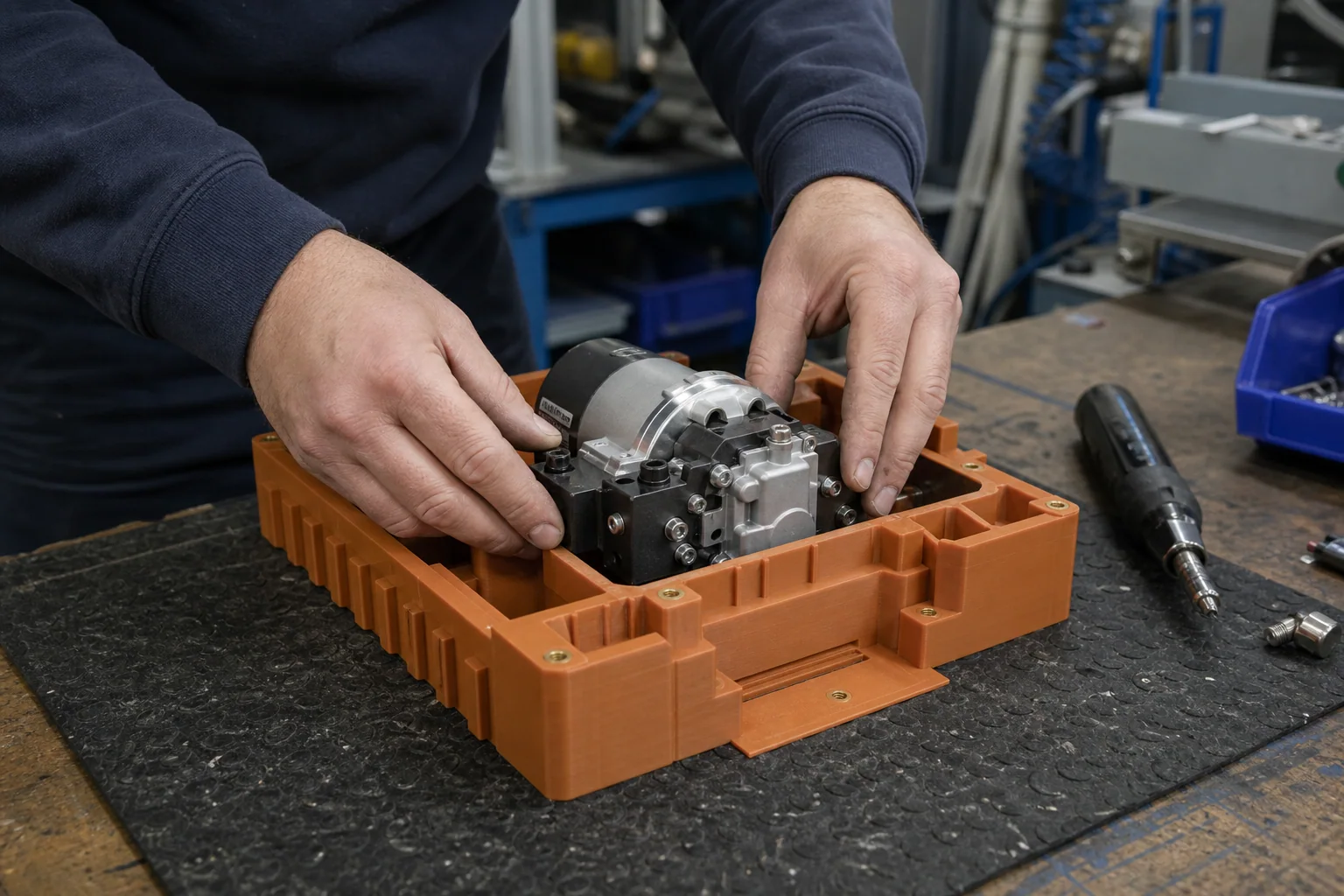
Material family names are not specifications. This page anchors the discussion to a named commercial grade and published printed-specimen data, then translates that data into practical selection and design guidance.
Glass fibre raises ABS stiffness and reduces distortion while retaining more colour choice than most carbon-filled materials. It is a practical option for visible fixtures, housings and structural workshop parts.
Choose ABS-GF when stiffness, colour and dimensional repeatability matter more than maximum impact toughness.
Orientation, conditioning and geometry can move finished-part performance materially. Use these figures to compare candidate materials—not as guaranteed minimums.
| Property | Representative value | Test / context |
|---|---|---|
| Density | 1.08 g/cm³ | Manufacturer TDS |
| Tensile strength | 36 ± 3 MPa | Manufacturer TDS |
| Elongation at break | 6.3 ± 1.2% | Manufacturer TDS |
| Flexural modulus · XY | 2.86 ± 0.13 GPa | Manufacturer TDS |
| Flexural strength · XY | 68 ± 4 MPa | Manufacturer TDS |
| Impact strength · XY | 14.5 ± 1.5 kJ/m² | Manufacturer TDS |
| HDT · 0.45 MPa | 99°C | ISO 75 |
| Vicat softening | 103°C | ISO 306 |
XY values normally represent flat-printed specimens. Z-direction strength can be substantially lower. Final production settings should be qualified on representative geometry.
A useful material choice starts with load case, temperature, environment, duty cycle and failure consequence—not the strongest number on a datasheet.