
Carbon-fibre reinforced nylon
PA6-CF

PA6-CF: High strength and stiffness for dry, heavily loaded structural components.

PA6-CF is one of the most capable structural FFF materials available without moving to ultra-high-temperature polymers. In the dry state it offers exceptional strength and heat resistance, but its engineering behaviour changes materially as it absorbs moisture.

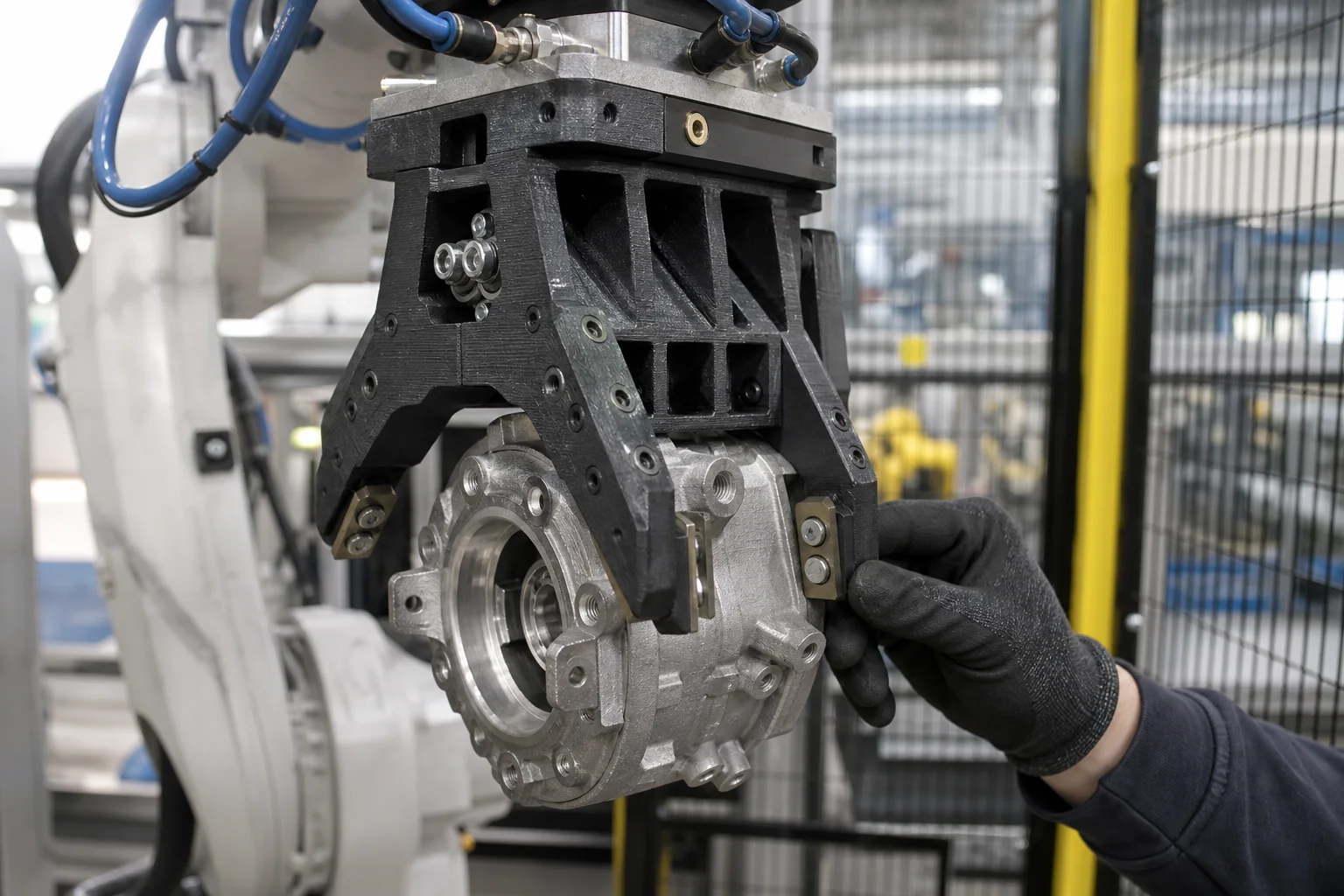
PA6-CF printed robotic end-effector gripping a machined aluminium transmission component
Representative applicationHigh-strength robotic end-effector with integrated metal interfaces

The engineer’s read.

Material family names are not specifications. This page anchors the discussion to a named commercial grade and published printed-specimen data, then translates that data into practical selection and design guidance.

What it brings

PA6-CF is one of the most capable structural FFF materials available without moving to ultra-high-temperature polymers. In the dry state it offers exceptional strength and heat resistance, but its engineering behaviour changes materially as it absorbs moisture.

Selection verdict

Choose PA6-CF for heavily loaded, heat-exposed parts when moisture conditioning is understood and controlled.

Printed properties.

Orientation, conditioning and geometry can move finished-part performance materially. Use these figures to compare candidate materials—not as guaranteed minimums.

PropertyRepresentative valueTest / context
Density1.09 g/cm³Manufacturer TDS
Tensile strength · dry102 ± 7 MPaManufacturer TDS
Elongation at break · dry5.8 ± 1.6%Manufacturer TDS
Flexural modulus · XY dry5.46 ± 0.28 GPaManufacturer TDS
Flexural modulus · XY wet3.56 GPaManufacturer method
Flexural strength · XY dry151 ± 8 MPaManufacturer TDS
HDT · 0.45 MPa186°CISO 75
Saturated moisture uptake2.35% · 25°C / 55% RHManufacturer method

XY values normally represent flat-printed specimens. Z-direction strength can be substantially lower. Final production settings should be qualified on representative geometry.

Selection logic.

A useful material choice starts with load case, temperature, environment, duty cycle and failure consequence—not the strongest number on a datasheet.

Advantages

  • Excellent dry-state strength and stiffness
  • High heat deflection for hot tooling and engine-bay-adjacent work
  • Carbon fibre limits warp and improves dimensional stability
  • Good wear behaviour for suitable grades and mating conditions

Watch-outs

  • Moisture materially reduces stiffness and strength
  • Conditioned dimensions can differ from dry-state inspection
  • Z-axis loads require explicit validation

Strong applications

Loaded jigs and fixturesRobot end-effectorsStructural machine partsHot-zone bracketsAutomotive prototypesProduction tooling